Showing posts with label fairies. Show all posts

Friday, July 13, 2012

A MIDSUMMER NIGHT'S DREAM

Before we go ahead with today’s story, I’d like to acknowledge a milestone: In three days’ time, "Once Upon a Time and Long Ago” celebrates its second anniversary. I remember when I started this pointless project two years ago with fifty fairy tales in a Word file and no idea what I was doing. Now, two years and an additional eighty stories later…well, I still have no idea what I’m doing. The truth is I never had any specific goal with this blog. Yeah, it would be nice if it picked up and became really popular. It would been great if a publisher comes across it and offers me a book deal. I wouldn’t be at all dissapointed if some of the girls who rejectd me in the past saw how clever and talented I was and regretted not giving me the time of day. As it is, none of that crap has, as of yet, happened. What did happen is I made a few people smile every now and then, kept myself actively writing at a time in my life when I had no other creative outlet, learned a lot about fairy tales and folklore, and maybe even made a few friends along the way. I guess the truth is that I’ve been writing this blog for myself all this time. I wanted to create something. A body of work I can point to and say “I made that.” As the years pass, it’s looking increasingly unlikely that I will ever be a professional writer, and that doesn’t really bother me. Because if there’s every any doubt, I can click a link and see my words and pictures there on the internet for all the world to enjoy. And, honestly, I've loved every minute of it.


If, however, you were so inclined, you could aide my writing career by purchasing and downloading my sci-fi/fantasy novel 'Dragonfly' from the Amazon Kindle store (Remember, even if you don't have a kindle, you can download the free Kindle app for iPhone, iPad, iPod Touch, Android, Windows Phone, Mac or PC). Or by buying one of my original designs at cafepress.com/GalleonsLap. I'm just sayin' is all!


Okay, now we come to the story itself: When people are talking about Shakespeare’s master works they are, almost without exception, talking about his great histories and tragedies like Richard III, Henry V, Hamlet, Othello and King Lear. But, to me, the real Shakespeare is to be found in the comedies. Here you find all the beautiful prose, the breathtaking poetry, and it has a happy ending. If I’ve made any point at all over the past two years, it’s that no writer in the history of language has ever been able to devise a better ending than “and they all lived happily ever after,” which is why I felt that this momentous occasion called for a good old-fashioned “Mega-Happy Ending.”

It’s worth noting that, according to many scholars who are pretty sure of themselves, most if not all of Shakespeare’s plays were based on older stories, so there could very easily be some ancient fairy tale, now, sadly, lost to us, about four lovers falling all over each other in the woods at night. Speaking of which, you’ll find no mention of Bottom or the “Crude Mechanicals” here. In the interest of simplicity, I have decided to relate only the story of the Athenian Lovers.


A wedding is supposed to be a happy occasion. It should be celebrated with loud music, cheap booze and people dancing up a storm who can’t actually dance even a little. Unfortunately, that was not always the case. It seems that in Athens (which is in Greece), there used to be this law that fathers got to choose who their daughters married. I know, it doesn’t make a lot of sense to me and we may never know whose idea it was to enact that silly law, but it was the law and that’s the point.

You see, there was this girl called Hermia who was in love with a boy called Lysander, and he, coincidentally enough, was in love with her. All things being equal, this would’ve been very good news, but for that silly law we mentioned earlier. See, Hermia’s father wanted her to marry this guy Demetrius who was, to be fair, a pretty nice guy, and probably would’ve treated Hermia pretty well, but she didn’t love him. It was beginning to look like Hermia would have to marry a man she didn’t love, or go away to a convent and never marry anyone ever for her whole life.

But Lysander was not the type to give up on true love (and, in fact, if you give up on it, it wasn’t really true love to begin with, now was it?). And he had an aunt who lived just outside of Athens. If he and Hermia fled there that night, they could get married outside of Athens where the law couldn’t touch them. Hermia didn’t like the idea of leaving her home and family forever…but it was preferable to leaving Lysander forever, so she consented.

And, again, we might have been just a hop, skip and a jump away from our happy ending, but Hermia couldn’t leave without saying goodbye to her bestest best friend, Helena. You see, Helena actually was in love with Demetrius, but he only had eyes for Hermia (brace yourselves, it’s actually gonna get a lot more confusing before we’re done here). So when Hermia told Helena that she and Lysander were eloping, hope dawned that maybe Demetrius would look her way. She wished her friends much luck and happiness and they were away and Helena went at once to talk to Demetrius…

“Do I lead you on?” said Demetrius, firmly. “Do I compliment you, give you false hope? Have I given you even the slightest indication that we will ever be together? No, I’m pretty sure I come right out and tell you, at every given opportunity, that I do not want you!

“Why not?” said an admittedly desperate Helena. “What’s Hermia got that I haven’t got?”

“Look, it doesn’t matter anyway. Tomorrow we’re getting married, so—”

“No you’re not! Tomorrow she’ll be married to…oops.” Hermia hadn’t counted on the fact that her bestest best friend couldn’t keep a secret to save her life. Needless to say, but apparently I’m going to, it took Demetrius all of forty-seven seconds to get Helena to spill the beans about the elopement. Knowing that the only way they could leave the city undetected was to go through the woods, Demetrius ran at once to catch them, with Helena following right behind.


Now, these particular woods, the ones just on the outskirts of Athens (what are outskirts, anyway? Are there inskirts?), were very unusual, as local legend had it that Oberon, King of the Fairies lived here with his band of magical fairies. And…he did! So, there ya go. Oberon didn’t usually get involved with human types, but every now and then when a suffering person swam into his purview, he was not above a little compassion. When, for example, two bickering young people in Athenian clothes came stomping through the forest, he took a moment to listen:

“It doesn’t matter what you do or say,” groveled Helena as she followed Demetrius closely. “Shout at me, insult me, reject me, push me away, it won’t do you any good. I’ll still love you.”

“You want me to insult you? Here: When I look at you, I feel phsically ill.”

“And I feel ill when I’m not looking at you. See how perfect we are for each other?”

“That doesn’t even make sense!”

I don’t care! I love you!”

Oberon saw this and thought it was…well, embarrassing, quite frankly. But, he could tell with that special sense of these things that only very magic creatures possess that this couple deserved a shot. So he sent for his righthand man, a mischevious fairy called Puck. “There’s a flower that grows on the very other side of the world,” he told his servant. “A drop of juice from this flower, when dripped into the eye of a sleeping mortal, will cause that mortal to fall hopelessly in love with the next person he sees. I want you to go get that flower, and drip it in the eyes of the young man who is traveling through our forest.”

“Yes, sir,” said Puck. “But how will I know this man?”

“He is traveling with a young woman and both are wearing the clothing of Athens. Now go!”

Puck obeyed and was back with the flower in forty minutes (which might seem like a long time, but remember he was literally going to the other side of the world). It took him less time to find two young Athenians sleeping on a grassy knoll. “Let’s see,” he said. “Man, woman, Athenian clothes. Yep! This must be them.” With that, he dripped a single drop from the flower into the eye of the young man and scampered away to help play a prank on his master’s wife and some actors…but that’s another story.


Now, I don’t want you to blame Puck for any of this. Neither he nor Oberon had any idea that there were two pairs of young Athenians wandering the forest at night. When Puck saw their Athenian clothes, he assumed they were Helena and Demetrius…but they were, in fact, Hermia and Lysander! And it was Lysander’s eyes into which Puck had dripped the love juice! Meanwhile, Demetrius had finally lost Helena and she was wandering through the forest alone. When she stumbled (literally) upon Lysander’s sleeping form, she was overjoyed at seeing a familiar face.

“Lysander? Oh, thank heavens! Have you seen…Lysander? Are you okay?”

Lysander was not okay, not really. He was looking at Helena very strangely. As though he was seeing her for the first time. The magic flower had done its job and Lysander was now, through no fault of his own, hopelessly and totally in love with Helena.

“Transparent Helena!” he said at last. “Nature shows art, That through thy bosom makes me see thy heart.” Turns out, being in love makes you talk funny. Who knew?

“Huh? Look, whatever, I need your help.”

“Of course. Anything. I’d do anything for you. I’d walk through fire, I’d swim the ocean, I’d slay a dragon and bring back its head to win your favor, fair Helena.”

“Fair Helena? What? Lysander, what are you talking about? I’m trying to find Demetrius.”

“Demetrius?” said Hermia. All this talk had woken her up. “Is Demetrius here? In the forest?”

“Yeah, I…I kinda let it slip that you guys were running away. I’m really sorry about that! And now he’s somewhere in the woods and I need to—”

“Demetrius?!?” cried Lysander. “Here? Then I shall duel him to the death for the hand of my beloved Helena.”

“Do what now?” said Hermia.

“Where is the swine who dares to claim my own sweet Helena’s heart?”

“What the heck are you talking about?” demanded Helena.

“How can I make it any clearer? I love you, Helena. You are my own heart’s desire. I will never be happy until I have won your heart and can call you my own.” Lysander was literally down on one knee as he said this. Hermia was speechless, as I’m sure you can imagine. Helena was very confused.

“What is this?” she said at last. “Some sort of joke? That’s it, isn’t it? ‘Oh, poor Helena! She’s in love with Demetrius but everyone’s in love with Hermia!’ Well it’s not funny!” So saying she stomped off into the woods to find Demetrius.

“Wait, my love!” said Lysander running after her.

“Your love? Wait, Lysander!” said Hermia running after the pair of them.


Well, Puck saw all this happen. And, while he personally thought it hilarious, he knew his master would be mad that he screwed up. So he searched the forest until he found Demetrius, sleeping on his own in another part of the forest. And, just as before, he dropped the juice of the flower into his eye and hid himself as who should come running up but everybody else in the story. Helena running away, Lysander chasing her, Hermia chasing him, all of them waking Demetrius who, the minute he saw Helena…well, you know.

“O Helena, goddess, nymph, perfect, divine!”

“Oh, not you too!” cried Helena. “It was annoying coming from Lysander, but this is too cruel.”

“Yes, Demetrius!” said Lysander suddenly. “Stay away from my Helena!”

Your Helena?” exclaimed Demetrius. “You love Hermia!”

“Love Hermia? No! I hate Hermia!”

“Excuse me?!?” said Hermia.

“I love Helena and we will be wed!”

“No, I love Helena, and we will be wed!”

Nobody loves Helena!” shouted Hermia, and then immediately regretted it. “I’m so sorry, Helena, I didn’t mean that. But…look, what is wrong with you two?” It was a little confusing for the ladies. Just a few hours ago, both men had been determined to marry Hermia, now they both seemed to be in love with Helena. Hermia thought they had gone mad, Helena still thought they were all playing a mean trick on her and the boys…well, they were so addled with that love potion they didn’t know what they were doing.

“I challenge you to a duel!” declared Lysander, and would probably have slapped him with a glove, except this was the middle of summer and it was too hot for gloves.

“I accept your challenge!” said Demetrius, who didn't let the lack of handwear stop him and slapped Lysander across the face with his bare hand.

It was about this point that Puck decided his little joke had run its course and he went to go tell Oberon. The Fairy King was, understandably, annoyed at Puck. “Did you screw this up on accident because you’re a fool, or on purpose because you’re making trouble again?”

"Er...whichever one will get me in the least amount of trouble?"

Oberon did not find this funny.

“I promise, King of Shadows,” said the contrite Puck. “It was an innocent mistake. You said to look for a man and a woman wearing Athenian clothing, and I did.”

“And when you dripped the juice into the second mortal’s eyes?”

“Yes, okay, that wasn’t great, I admit. Still, you have to admit, it’s a little funny, right?”

Oberon didn't find that funny either.

“I don’t want those two killing each other!" bellowed the Fairy King. "I know where I can find an herb that will set everything straight. But you have to stop them fighting until I come back. Can you handle that?”

Puck said he could and he went at once to where Lysander was sharpening his sword and preparing for battle, while Hermia stood by him, begging him to come to his senses.

“Come out, Lysander, you coward!” said Puck, but he said it in Demetrius’ voice (which is a thing fairies can do, you know).

“You dare call me a coward? Then show yourself!”

“Follow my voice and we shall do battle this very night!” Using his magic, Puck made it sound like Demetrius’ voice was coming from deep in the woods, so Lysander tore into the trees to fight his imaginary foe, Hermia right on his heels.

Meanwhile, in Demetrius’ corner, Helena was doing some pleading of her own, when:

“Enough waiting!” came Lysander’s voice, courtesy of Puck. “Come get me and we’ll settle this right now!” And, just as Lysander had done, Demetrius followed the magical voice with Helena close behind him. Now both men, and their respective ladies, were walking further and further away from each other, convinced that they were getting closer and closer. Once they were at a safe distance, Puck cast a spell which put all four Athenians to sleep instantly.

“Lord, what fools these mortals be!” he said to himself as Oberon returned with the magic herb and worked one final spell before the dawn…


The next morning, Hermia was awakened by the bright sun shining on her face. She started to get up to draw her curtains, only to realize that she was not in her bed. She was lying on a grassy knoll in the forest. Memories of the night before came flooding back to her and her eyes quickly fell upon Lysander’s sleeping form a few feet away.

“Lysander? Lysander, wake up!” she said, shaking him gently.

“Hermia?” said Lysander, groggily. “I…I was having the strangest dream…or was it a dream?”

“I don’t know,” said Hermia. “But I think maybe we should get out of these woods.” They walked hand in hand, back the way they had come, in the hopes of finding their way to Lysander’s aunt’s home…but in retracing their steps, they found something they hadn’t expected: Another soft patch of earth in which Demetrius and Helena were asleep in each other’s arms.

“Demetrius? Helena?”

They both awoke at hearing their names and, like Hermia and Lysander, seemed to take a moment for their memories to return.

“How did…When did…Did we…Did I?” said Demetrius.

“Just what I was thinking,” said Lysander.

“I feel like I’ve been dreaming,” said Helena. “But I can’t for the life of me remember what I dreamed. Not clearly, anyway. Bits and pieces.”

“Same here,” said Hermia. “Maybe they’re right when they say these woods are enchanted.” They all agreed that it was possible. Had they seen the pair of eyes watching them and smiling before he went to sleep, they would’ve been certain.

A few hours later saw all four standing before Hermia’s father. Hermia and Lysander were hand-in-hand, as were Demetrius and Helena. They explained, as well as they could, the current state of affairs. Hermia’s father was confused, but even he had to admit that it was silly forcing two people to get married if neither one wanted to and gave his consent.


A wedding is supposed to be a happy occasion. It should be celebrated with loud music, cheap booze and people dancing up a storm who can’t actually dance even a little. And, if it’s a double wedding, there should be twice as much music, twice as much to drink, and twice as many terrible dancers taking up room on the floor from those who actually know what they’re doing. But the best part of a double wedding is that it means twice as many people are living happily ever after.

THE END


If You Liked My Story, You Might Enjoy:

  • A Midsummer Night's Dream (1935) In this adaptation, Mickey Rooney is Puck and James Cagney is Bottom. Also stars Olivia De Havilland, Dick Powell and Joe E. Brown.
  • A Midsummer Night's Dream (1999) This more lavish, colorful version stars Stanley Tucci as Puck, Rupert Everett as Oberon and the Athenian lovers are played by Christian Bale, Dominic West, Anna Friel and Calista Flockhart.
  • Disney's House of Mouse (TV) One episode featured a short version of the story which, like mine, focuses on the young lovers. Goofy's Puck is more absent-minded than mischevious and the couples are, of course, Mickey and Minnie, and Donald and Daisy (admittedly it was a little weird for this long-time Disney fan to hear Mickey shout "I'm yours, baby" to Daisy Duck, but otherwise pretty cute).

NEXT WEEK: Sasha and the Other

Friday, June 29, 2012

Prince Darling


This one is another that I first heard through “Fractured Fairy Tales” and was astounded to find was an actual, real fairy tale. This one also comes to us from Andrew Lang, though there’s no telling where he heard it. Halfway through writing my version, I realized it made a pretty good practical demonstration of “irony,” which some people (I’m talkin’ to you, Ma!) still have a hard time with.


A lot of people are confused about irony. Basically, it means to use words to mean something other than their literal meaning or when things are the oposite of what you’d expect. So, for instance, if a professional woodcutter found himself with nothing to build a fire, that would be ironic. If a hairdresser was bald, that would be pretty ironic. If it rains on your wedding day, that’s not ironic, just unfortunate. Or, if, for example, a man’s name was Darling but he was actually cruel, selfish and unkind, that would be very ironic. It would also be what this story is about: Prince Darling.

Prince Darling’s father was, as you may have been able to deduce for yourselves, a king and he was known to be an honest, benevolent, merciful king who gave a care. In fact, he actually was darling (which, if his name had been something like “Meanie” or “Jerkface” would have been ironic, but since his name was Dennis, it wasn’t. Are we pretty clear on irony as a concept? Good. On we go). One day King Dennis was out walking in the woods, thinking about all the nice things in his life.

“I like my castle…I like my court jester…I like spaghetti…I like sitting in the big, comfy throne…I like rabbits. Like that one!” And sure enough a little white rabbit ran straight up to him, terrified by something and leapt right into the king’s arms. “There, there, little bunny,” said the king. “You can come home with me. I’ll take care of you.” So the king took the bunny home and saw to it that she was well taken care of.

That night the king was awoken (awakened? Awokened? How the heck do you say this?) by a strange visitation. A beautiful woman in a white gown appeared to him. “Good King Dennis,” she said in a voice that was nothing short of angelic. “I am the Good Fairy, Melisande. I heard that you were very kind, so I disguised myself as a cuddly bunny, knowing that only a real jerk could be mean to a cuddly bunny. Because you have proved yourself worthy, I will grant you a wish.”

Well, the king thought about it for a moment, but in the end it was clear what he should wish for. “Nothing in my life is more precious to me than my son, Prince Darling. Unfortunately, I’m worried that he might be on the wrong path. For my wish, I would like you to look after my son and do what you can to make him a good man and a good king.” The fairy agreed to do this and, a few years later, when the king passed away, she set to work.

Prince Darling loved his father very much and missed him terribly. Other than that, he was super-psyched to be the king! It’s worth mentioning at this point that kings in those days didn’t usually take a very active role in their kids’ upbringing. Darling had been raised by a governess (which is like a nanny) who was not very strict with him. She gave in to his every tantrum, his every slightest whim was granted. As a result, Prince Darling as a young man was very, very spoiled and selfish. And his idea of a king’s duties basically involved doing whatever he wanted all the time and arresting anyone who tried to stop him.

Clearly, Melisande had her work cut out for her.

She appeared to King Darling as she had appeared to his father: as a cute, cuddly bunny. When Darling drew his crossbow, however, she knew this wasn’t gonna work, so she turned back into a lady. “I promised your late father that I’d look out for you,” she said, sternly. “Now I can’t force you to be a good person, but maybe I can help you to realize when you’re being bad.” With that, she slipped a gold ring onto Darling’s finger. “Everytime you do or say anything you shouldn’t, that ring will prick your finger like a needle. Hopefully, that will teach you the difference between right and wrong.”

And, really, that should’ve worked. When Darling did something small, like get into a temper for not getting his way, he felt a small pinprick on the ringed finger. When he did something worse, like shouting at the servants, it was more like the tip of a knife pricking him. And when he did something really awful, like kicking a puppy (seriously, who kicks a puppy?) the ring actually made his finger bleed. At first, when he felt the pain, he stopped what he was doing and tried to do the right thing. But after a while he got really sick of it.

“I’m the King!” he shouted to no one in particular. “Why should I let some stupid fairy tell me what to do?” So he pulled the ring off his finger and hurled it into the lake. There it was promptly swallowed by a fish who, two days later, was caught by a fisherman who found the ring and gave it to his wife who had an unfortunate habit of judging her neighbors and gossiping about them. But now, every time she did, the ring pricked her finger and she learned to be kinder to others, which just goes to prove that the ring bit would’ve worked on anyone but Darling.

At any rate, the now un-ringed king was riding through his country one day, when he saw a beautiful shepherdess by the side of the road. Captivated by her great beauty, he rode up to her and announced that she would marry him.

“No, sire,” said the shepherdess. “I am in love with another. A young man from my village. I will marry none but him.”

“But I am your king and I have great love for you.”

“If you truly loved me, sire, you would want me to be happy and marry the man I choose.”

“Nonsense!” said King Darling. “I’m the king, I want you, so I get to have you. That’s how this works! Now marry me or be put to death.”

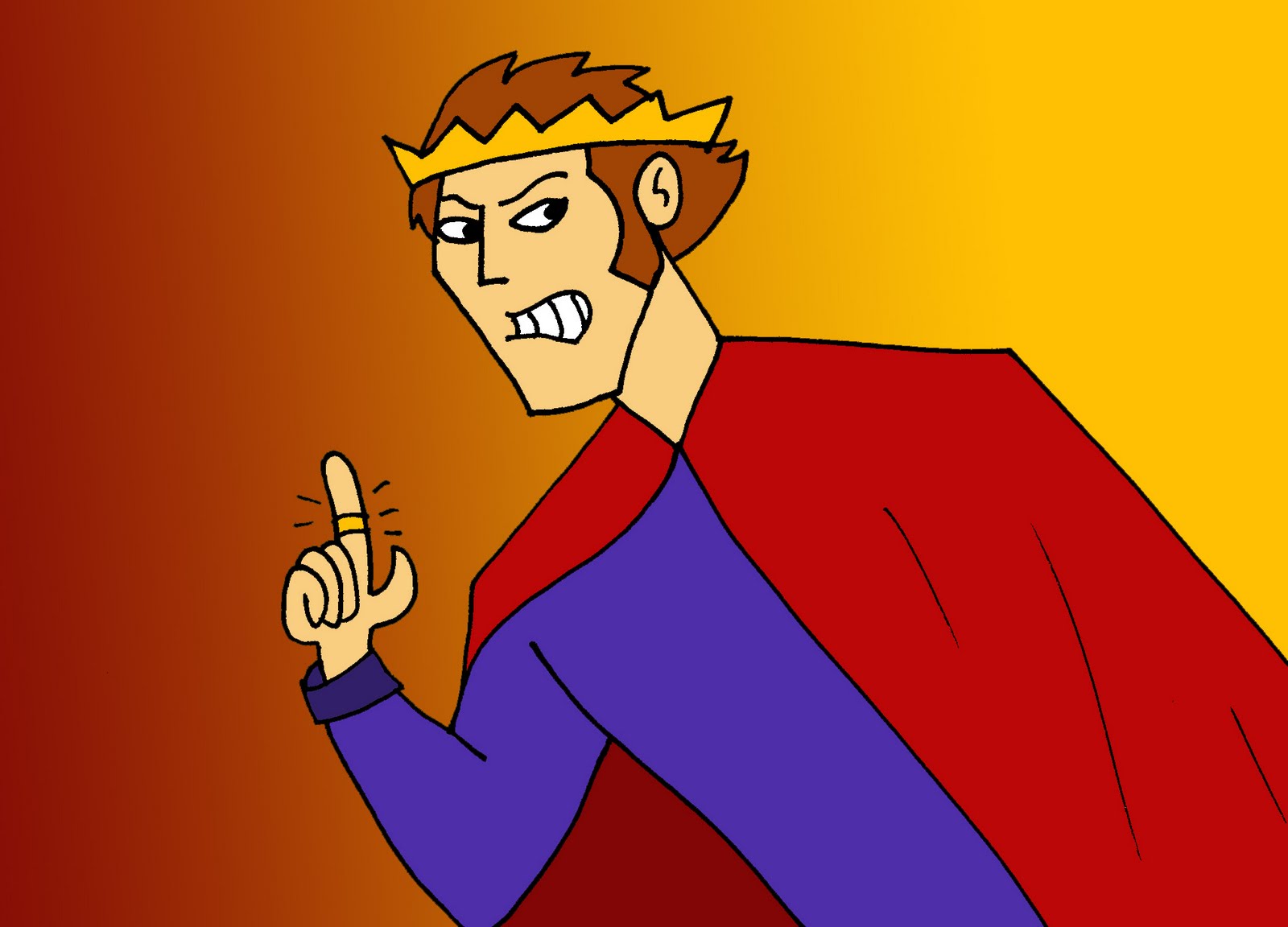
“I think…neither!” And in a flash, the shepherdess had turned into Melisande, glaring angrily at King Darling. “I thought I would give you one last chance to do something right. But, I daresay, after all these years of thinking only of yourself, you’ve forgotten how to do anything right. You may look like a man on the outside, but on the inside you are a monster! And I think it’s about time you looked the part!” The fairy waved her hands and cast a spell on King Darling. Another flash and she was gone, and the king was transformed into…into a…a sort of…he was. Well, he looked kinda like this:


Not so much pretty, huh?

Melisande had made it so that Darling looked as nasty on the outside as he was on the inside. He couldn’t even talk anymore. All anyone heard was a horrible snarling sound. He couldn’t go home in this state, so he ran deep into the forest, to hide from all the world.

At first, Darling simply cursed Melisande's name and blamed her, and his father, for everything that had happened to him. But solitude is great for self-reflection, and after a few weeks of living in the woods, hiding from all other living beings (except, I guess, trees and stuff), Darling began to understand that some of the fault was his…a few weeks later, it occurred to him that most of the fault was his…after six full months, he accepted that it was all his fault. He had thought only of himself and treated others with cruelty and what had happened to him was all he deserved.

As luck would have it, it was on this day that Darling, feeling so sorry for himself that he didn’t look where he was going, fell into a deep, dark pit that hunters had dug to catch bears and the like. When the hunters saw Darling in the pit, however, they didn’t know what to make of him. Or even what to call him. In the end, they decided that he would make a great addition to the royal menagerie, so they packed him in a cage and took him to the palace.

Darling was apprehensive at the thought of returning to his palace after all this time. True, he’d only been gone three months, but he didn’t know what to expect when he got back. He thought maybe his people would still be looking for him, wondering what had become of him. Maybe they took him for dead and were still in mourning over their lost monarch. He certainly didn’t expect a coronation to be going on.

“WHAT?!?!” he shouted, though it sounded like a horrible growl to everyone around him.

“Yes,” repeated one of the hunters to the palace guard. “A brand new kind of animal, just discovered in the forest. We’d like to give it as a gift to the new king.”

Darling’s cage was taken into the throne room and presented to the man who would soon be crowned king. To Darling’s surprise, it was his old tutor, a kindly old man who had always loved Darling like a father. From the conversations he’d overheard upon his arrival, Darling surmised that he had been made steward of the throne once he, Darling, had gone missing all those months ago. As steward, his job was to keep the kingdom running in the absence of her rightful monarch. But, as it turned out, he was a much better king than Darling. He cared about other people, he was unselfish, he was generous, merciful, compassionate. He was very much like the late, great King Dennis, in fact. So the people of the kingdom had decided to make it official and crown the steward king. None of them even seemed to care what had happened to Darling!

“Please, please, my people,” said the steward as he addressed the assembled. “I accept the throne of this kingdom only because you demand it, and as king, I am nothing if not a servant to my people.” This struck Darling as odd, but he kept listening. “In my heart, however, I know I am only filling in for our true king, young Darling, who went missing only three months ago. I know he wasn’t perfect.”

“That’s for dang sure!” cried someone in the crowd.

“But I knew him all his life,” continued the steward, unperterbed by this interruption, “and I knew his father before him. And I saw in Darling the potential to be a great king. I would give my very life to see him in his rightful place on this throne.”

“Works for me!” growled Darling and with the great animal strength he now possessed, he tore his way out of the cage and lunged straight for the steward. But before he could strike a killing blow, he looked into the old man’s eyes. And he saw the eyes of the kindly tutor who had patiently taught him for all those years. And the eyes of the good, wise fairy who had given him so many chances to change, each of which he had ignored. And the eyes of his dear, departed father who had one wish, and used it to make his only son a better man.

Darling realized that he couldn’t do it. The country was better off without him. He wanted to be a good king, but the first step was putting the needs of his people ahead of his own. So he went back into his cage and covered his face with his paws.

“Darling,” came a familiar voice. “You have finally proved yourself worthy of the crown. Now get up. Your people are waiting for you.”

As Melisande’s voice faded away, Darling looked up. The first thing he saw were his hands. Not paws, mind you, but hands. He was still in the cage but he had turned back into his old self. All the guests at the coronation were shocked at what they had seen, but they knew their long lost king when they saw him…and they also remembered what a jerk he was so, fearful for their lives, they all started to cheer.

“No!” cried Darling. “I don’t deserve applause or cheers. I have not been the king you deserve. The king my father wanted me to be. But I have learned a lot recently, and I want a second chance to serve you all better, even though I know I don’t deserve it.”

“If that’s how you feel,” said the steward. “You do deserve it. Hail, King Darling! Long live the King!” And so, the coronation went ahead as planned, with only one slight change: It was our old friend Darling who was re-crowned king. Only by giving up the throne could he prove himself worthy of it, and only by becoming a monster could he learn what it was to be a man.

And it doesn’t get much more ironic than that!

THE END


NEXT WEEK: "The Enchanted Bridegroom"

Friday, May 4, 2012

The Faeries, The Ogres and the Three Curses


As tomorrow is Cinco de Mayo, I thought it would be appropriate to share a traditional Mexican fairy tale. This one is known to the people of Mexico as “Domingo Siete,” or “Sunday Seven.” I have tried to remain as reliable as possible to the original while imbuing it with my own style. I have named the two central characters after two renowned Mexican filmmakers. Feliz Cinco de Mayo, Amigos!


Also, don't forget my still readily available sci-fi/fantasy/comic/romance/adventure novel which can be downloaded here at a very reasonable price.


Once, and only once, upon a time, there lived two hunchbacks named Alonso and Guillermo. Despite sharing a deformity, you couldn’t find two more different people if you tried. For while Guillermo cursed the world for his misshapen body and outcast status, Alonso remained cheerful and optimistic in the face of adversity. Hunchbacked as they were, they could not live among other people without being ridiculed, tormented and abused, so they lived in the forest and earned their Daily Bread (which is a special variety of bread available only in certain parts of the world) as woodcutters…

Or, rather, Alonso earned his bread as a woodcutter. Guillermo, however, was lazy, selfish and not really all that nice a guy, so he would often make excuses as to why he couldn’t work. Alonso, being kind and good natured, would consent and do all the work for the pair of them. He wasn’t what you might call enthusiastic about this arrangement, but kind people are always kind, so he spent most of the day chopping away for the sake of his lazy associate.

By the time he was done with the day’s work, it was very late. Too late to head for home. So he set up camp in the forest for the night. But as he was drifitng off to sleep, he heard a strange sound. It sounded like singing. But no human voice could be that lovely. He decided to investigate. Treading carefully, so as not to give himself away, he followed the sound of the singing to a small, secluded glade. Alonso’s suspicion about the voices not being human was quite right. Here he saw a band of faeries dancing and frolicking and singing:

Lunes y martes y miƩrcoles tres...
Monday and Tuesday and Wednesday three…

Alonso recognized the old song at once, but the faeries were only singing the first line over and over again. It was as if they simply didn’t know the rest of the song. Alonso was so moved by their beautiful voices, he wanted to help, so the next time they sang “Monday and Tuesday and Wednesday three…” Alonso came out of hiding and sang, “Thursday and Friday and Saturday six!”

The faeries were initially shocked that a mortal had found their hiding place, but when they realized he had told them the rest of the lyrics to their song they were delighted. I mean, you know how frustrating that can be when you have a song in your head but you don’t know all the words. At the moment, for example, I have “You Can Do Magic” by America in my head and all I know is the bit that goes “You know darn well/When you cast your spell/You can get your way/When you hypnotize/With your…”

But, I digress.

The faeries invited Alonso to join the party and they sang and danced together into the night. And the curious thing was that, even though he had worked hard all day and hadn’t yet slept, he didn’t feel tired. He felt wide awake and full of joy, thanks to the faeries’ magic.

And that wasn’t all! The faeries grew so fond of Alonso that they wanted to pay him a kindness. They all flew around him and bathed him in their magical light and when they were done, the hump was gone from Alonso’s back! He was whole and healthy and strong! He was about to say how grateful he was to his new friends when a terrible rumbling was heard getting closer and closer. “It’s the ogres!” the faeries cried. “Quick, get up in the trees or they’ll see you!” Alonso didn’t need to be told twice and he scurried up the nearest tree (much easier to do now that his deformity was gone) and hid in its branches. Once he was settled, he looked down but the faeries had all vanished, as had all evidence of their party, and three huge, ugly ogres settled down in the clearing to rest and talk about the mischief they had caused.

“Well, amigos,” said the first ogre. “As we are all here, I can now call this annual meeting of the Evil Ogres Society to order.” And so the meeting began and, as with all formal society meetings like this, the first twenty minutes or so were pretty uneventful. Just the minutes from last year’s meeting, points of order, old business, procedural things like that which are the cornerstone of a well-run society, but which are murder for storytellers. Finally, just as Alonso was about to nod off from boredom, they got to the good stuff. “Now the chair will hear reports on the evil deeds performed in the previous year. The chair recognizes Brother Diego.”

The ogre, evidently called Diego, stood and addressed the others. “This has been a good year for me,” he began. “I found a small, unspoiled village full of good, hard-working, honest, pious, happy people. So, naturally, I had to do something about that.” The other ogres laughed, but Alonso listened with rapt attention. “I’ll spare you the details, but the upshot is…they are all blind! Every man, woman and child in the village is blind as a bat! Thank you.” The other ogres clapped and Diego sat. The chair then reconized the next ogre, name of Garcia.

“I too found a village of no-account do-gooders, as did Brother Diego, and I too felt the need to make them suffer for their innocence. Every single citizen of that village is now deaf and can’t even hear the thunder!” This report was also met with warm and appreciative applause. Alonso couldn’t help but admire how formal and polite these horrible monsters were...but only briefly before getting back to the business of loathing them for their evil deeds.

“As for me,” said the Chair-Ogre, “I had some fun with the village I found as well: I struck them all mute! No one can talk or laugh or cry or shout. They are silent!” Alonso was disgusted by the glee with which these monsters talked about punishing innocent people. He was all set to leap from the tree and attack them all, which would likely have gotten him killed almost instantly, when he heard something that made him stop at once.

“The thing that makes it all so funny,” said Diego, “is how easy it would be to cure them, if we wanted to!”

“Oh, yes,” agreed Garcia. “It would be the work of but a moment to release these pitiful people from these curses…but we won’t!”

“Gentlemen, please,” said the Chair-Ogre, trying to restore order. “For the sake of posterity, let us all say how we can cure our victims. In my case, all they would have to do is go to the fields and pick flowers from the cenizo plant. A tea brewed from this flower will cure muteness.”

“My village,” began Garcia, “is in the shadow of the Hill of the Bells which is covered in giant stones, but one of them is actually a bell in disguise. Strike that stone with a heavy hammer and the sound will echo throughout the village, curing everyone’s deafness.”

“If my victims wanted to cure their blindness,” said Diego, “they would have to wait until the first week of April and collect all the dew from the grass in the morning. Rub that dew into their eyes, and they’d all be able to see at once!”

“Well," said the Chair-Ogre, "I don’t think there’s any fear of our curses being undone any time soon! I mean even if these people were to somehow find out how to cure their various afflictions, it would take some kind of superman, or perhaps a man who has worked hard all his life, become strong and accustomed to hard work and who has, possibly, recently undergone some kind of physical change making it easier for him to move his body." The laughter of the ogres rang through the trees like dramatic irony. "So, if there’s no more business, I hereby adjourn the meeting. We will meet back here in one year.” The ogres disbanded and wandered off into the woods.

Alonso climbed down his tree. The faeries paid me a great kindness by removing my hump, he said to himself. I should try and help others the way they helped me. Starting with curing these poor, unfortunate villagers. So resolved, Alonso set forth on his adventure.


He didn’t know where any of the villages were, but it turns out it’s not that hard to find a village entirely peopled by the blind, deaf or mute and before long he was standing at the outskirts of the Mute Village. Though unable to speak, the people heard quite well and understood Alonso when he explained how they could be cured. The villagers wasted no time, but rushed out into the fields and picked every cenizo flower they could find. The tea was brewed and served to everyone in the town, and they could all speak once again! They were so grateful to Alonso that they gave him a burro laden with silver.

Next he went to the Village of the Deaf where he used some of his silver to buy a heavy sledgehammer with which he climbed the Hill of the Bells. He found the place the ogre had spoken of and began pounding every stone he could find. After striking one hundred and thirty-six stones and just before collapsing in utter exhaustion, he swung his hammer one last time and when it collided with the one hundred and thirty-seventh stone, the sound of a great bronze bell echoed across the village and all were cured of their deafness. Alonso was rewarded with a second burro, this one loaded with gold.

By now, it was the first week of April, and Alonso carefully gathered up each and every single drop of dew from each and every single blade of grass. Then he dipped his fingers in it, ran up to the first person he saw, and rubbed her eyes gently with the dew.

“Hey! Just what do you think you’re—” But the senorita was not angry anymore, since her blindness was cured…by a very handsome stranger. Alonso explained the situation to her, and the two of them spent the rest of the day curing each and every villager so that by sundown, there wasn’t a blind eye in the village. They even cured an old beggar who had actually been blind since birth and was, therefore, not affected by the ogre’s curse, but who was, nevertheless, grateful.

Unlike the first two villages, this one was not rich and they didn’t have any silver or gold to give him. As it happened, they did have something far more precious to offer him as a reward and when Alonso left for home, it was with a burro loaded with silver, a burro loaded with gold, and the beautiful girl he had cured first who had fallen in love with our hero which is, let's face it, always a nice thing to happen in a fairy tale.


It was, indeed, a joyous homecoming for Alonso and his new love. When he had last set foot in his home village a year ago, he was a misshapen woodcutter without two coins to rub together (which was actually a pretty common practice back then...no, no it wasn't, I'm just being silly). Now he was strong, handsome, rich and engaged. Not to mention famous for his heroic deeds. He was welcomed with open arms by everyone…except Guillermo, who was jealous of Alonso’s good fortune.

“Why should he get all this, but I have to remain a hunchback?” Guillermo thought. “I know! I’ll go into the woods and find those faeries. That should do it!”

So that night, Guillermo crept into the woods just as Alonso had done the previous year. And, sure enough, he did hear voices which he followed to that same clearing. Unfortunately, these were the voices of the ogres, who were meeting slightly earlier this year because they had a serious problem to discuss:

“It seems all of our curses have been cured,” said the Chair-Ogre. “And I thought we were the only ones who knew how to do that.”

“It wasn’t us,” said the other two. “Apparently, some woodcutter came and cured everyone. He must’ve been spying on us last year.”

It was at this moment that the faeries came out to play, not knowing the ogres were already here. Fearlessly, they began to sing:


                    Monday and Tuesday and Wednesday three…
                    Thursday and Friday and Saturday six…

Seeing his opportunity to share his friend’s good fortune, Guillermo leapt out of his hiding place and cried out:

“And Sunday seven!”

Which was a mistake because, not only was that not the next line of the song, but now the ogres thought he was the traitor who had eavesdropped on them the year before. That was the last anybody ever heard of Guillermo and even I don’t know exactly what happened to him, though there were rumors in a neighboring village of a horrible monster that lived in the forest with not one, but two ugly humps on his back.


And that’s the story of the two hunchbacks who lived in the woods and how the one who was kind, friendly and hard-working had great adventures and great reward, and how the one who was mean, cold and lazy suffered …which makes for a pretty good moral to any story, if you ask me.

THE END

Next Week: "The Big Ole' Tree"